
Heart Disease in Boxer Dogs: Signs & What to Watch (Vet Verified)

Heart disease in Boxer dogs is a serious problem, but in the right conditions (especially with early detection) it can be managed. In this article, we’ll explain all about it – understand what this condition consists of, what you should keep an eye on, and how you can help your pup. Let’s dive in!
What Is Heart Disease in Boxer Dogs?
Heart disease in Boxer dogs is a serious and often inherited condition that can affect dogs of any age, though middle-aged and senior Boxers are at highest risk. Boxers are uniquely predisposed to a condition called arrhythmogenic right ventricular cardiomyopathy (ARVC), which may cause no obvious symptoms in its early stages. Knowing the signs and monitoring your dog regularly can make a real difference.
Key Takeaways
- Boxers are genetically predisposed to ARVC, a form of heart disease that affects heart rhythm
- Early-stage heart disease in Boxers is often silent; subtle changes in breathing rate, activity, and rest patterns may be the first clues
- Regular veterinary screening, including Holter monitoring, is recommended for the breed
- Tracking resting respiratory rate and heart rate trends at home supports earlier detection between vet visits
Why Are Boxer Dogs Prone to Heart Disease?

Boxers have a well-documented genetic predisposition to certain heart conditions, particularly those affecting heart rhythm. Unlike large breeds that tend to develop dilated cardiomyopathy (DCM), Boxers are most commonly affected by ARVC, sometimes called “Boxer cardiomyopathy.” This condition is caused by a genetic mutation that leads to abnormal heart muscle tissue, making the heart more prone to electrical misfires (Cornell University College of Veterinary Medicine).
Because the condition is inherited, Boxers with an affected parent or sibling are at higher risk. Responsible breeders screen their dogs, but owners of any Boxer, especially those over three years old, should be aware of the risks and discuss screening with their veterinarian (Texas A&M Veterinary Medicine & Biomedical Sciences).
What Types of Heart Disease Do Boxers Get?
Arrhythmogenic Right Ventricular Cardiomyopathy (ARVC) ARVC is the most common and breed-specific heart condition in Boxers. It causes ventricular arrhythmias (irregular heartbeats originating in the lower chambers of the heart) and can range from asymptomatic to life-threatening. In severe cases, it can cause sudden cardiac death, even in dogs that appeared healthy. (Texas A&M Veterinary Medical Teaching Hospital)
Dilated Cardiomyopathy (DCM) Though less common in Boxers than in some other large breeds, DCM can also occur. It causes the heart muscle to weaken and the heart to enlarge, reducing its ability to pump blood effectively. (Cornell University College of Veterinary Medicine)
Aortic Stenosis Some Boxers are also predisposed to aortic stenosis, a narrowing of the aortic valve that makes the heart work harder to pump blood. This is typically identified by a heart murmur during a routine examination. (VCA Animal Hospitals)
“I got the Maven sensor for my 14-year-old Chihuahua mix with heart and trachea issues. It gave me back peace of mind – I can track her RRR, BPM, drinking, and activity anytime and know instantly if something’s wrong. Highly recommend!”

★★★★★
Chiara De Luca
Titti
What Are the Early Signs of Heart Disease in Boxers?
“Boxers are predisposed to specific heart conditions that may not show obvious symptoms early on. Monitoring heart rate and rhythm trends can help catch changes sooner.” Carolina Domingues, DVM, Veterinarian at Maven Pet
Heart disease in Boxers can be deceptively quiet. Many dogs show no symptoms until the disease has progressed significantly. When signs do appear, they may include (VCA Animal Hospitals):
- Fainting or collapse (syncope): often triggered by exercise or excitement; a hallmark sign of arrhythmia in Boxers
- Exercise intolerance: tiring more quickly than usual, reluctance to play or go on walks
- Increased resting respiratory rate: breathing faster than normal even at rest, which may signal fluid accumulation
- Coughing: particularly at night or after lying down, which may indicate fluid in the lungs
- Reduced activity or increased rest: spending more time sleeping or seeming less engaged
- Weakness or general lethargy
Because many of these signs develop gradually, they are easy to overlook or attribute to normal aging. That’s why baseline monitoring matters.
How Is Heart Disease Diagnosed in Boxers?
Veterinarians use several tools to diagnose and stage heart disease in Boxers:
- Physical examination and auscultation: listening for murmurs or irregular rhythms with a stethoscope
- Electrocardiogram (ECG): a short recording of the heart’s electrical activity to detect arrhythmias
- Holter monitoring: a 24-hour continuous ECG recording worn as a small device; this is considered the gold standard for detecting ARVC-related arrhythmias in Boxers, since irregular beats may not occur during a brief in-clinic ECG
- Echocardiogram (cardiac ultrasound): evaluates heart structure and function, including wall motion and chamber size
- Chest X-rays: assess heart size and detect fluid accumulation in or around the lungs
- Genetic testing: a DNA test is available to identify the mutation associated with Boxer ARVC, though a negative result does not fully rule out disease (NC State Veterinary Hospital)
Breed organizations such as the American Boxer Club recommend annual Holter monitoring for breeding dogs and encourage screening for all Boxers showing clinical signs.
Living With a Boxer With Heart Disease

A diagnosis of heart disease is not necessarily a crisis. Many Boxers with ARVC live comfortably for years with the right management. Treatment depends on the severity of the condition and may include:
- Anti-arrhythmic medications (such as beta-blockers or sodium channel blocker) to reduce the frequency and severity of abnormal heartbeats
- ACE inhibitors or diuretics in cases where the heart muscle has weakened or fluid is accumulating
- Activity modification: your vet may recommend limiting high-intensity exercise if arrhythmias are frequent or severe
- Regular monitoring: follow-up Holter monitors and echocardiograms help track disease progression and guide treatment adjustments
Open communication with your veterinarian is key. Many owners find that understanding the condition and having a clear monitoring plan reduces anxiety and helps them feel more in control.
What Should Owners Monitor at Home?
Home monitoring is one of the most meaningful things a Boxer owner can do between veterinary visits. The two most important metrics to track are:
Resting Respiratory Rate (RRR) Count the number of breaths your dog takes in one minute while they are fully relaxed or sleeping. A normal resting respiratory rate in dogs is under 30 breaths per minute (Cornell University College of Veterinary Medicine). A rate consistently above 30, or a sudden increase from your dog’s personal baseline, warrants a call to your veterinarian.
Heart Rate and Rhythm While it is difficult to detect arrhythmias by feel alone, a resting heart rate that is unusually fast, slow, or irregular can be a meaningful signal.
Activity and Rest Patterns Reduced activity, increased napping, or reluctance to engage in normal routines can all be early behavioral indicators of cardiovascular strain.
Keeping a log, or using a monitoring device, helps you and your vet identify trends that would be invisible in a single snapshot.
How Maven Helps Track Heart Health in Boxers
The Maven Pet Health Monitor is designed for exactly the kind of continuous, passive monitoring that matters most in breeds like the Boxer. Maven tracks heart rate, resting respiratory rate, activity levels, rest patterns, scratching, and water intake around the clock, without requiring anything from your dog.

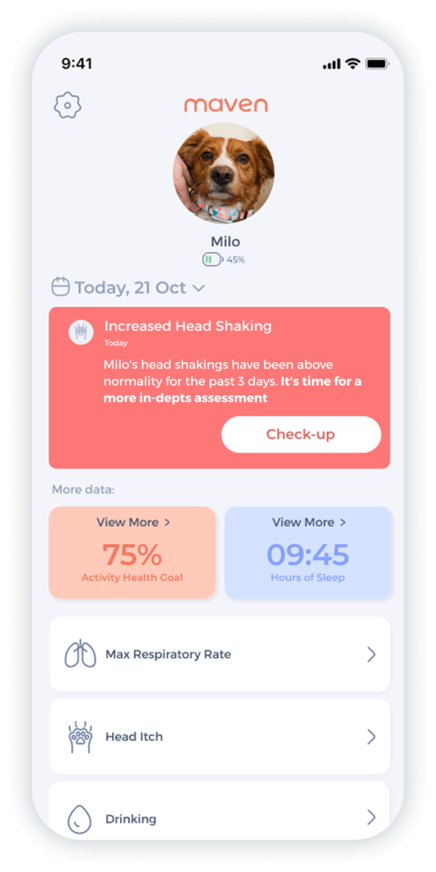
Monitor heart rate, respiratory rate, activity & rest, drinking, itch behavior.
For Boxer owners, this means early deviations from your dog’s personal baseline can be flagged automatically. A gradual increase in resting respiratory rate, a drop in daily activity, or a shift in rest patterns may appear in the data days before your dog shows obvious symptoms. Maven builds a personalized baseline for your individual dog and sends alerts when meaningful changes occur, giving you and your veterinarian an earlier, clearer picture of what is happening between visits.
Learn more about the Maven dog heart rate tracker
FAQ (Vet-reviewed)
Boxers are most commonly affected by arrhythmogenic right ventricular cardiomyopathy (ARVC), a genetic condition that causes abnormal heart rhythms. They may also develop dilated cardiomyopathy or aortic stenosis, though these are less breed-specific.
Early signs can be subtle and include increased resting respiratory rate, reduced activity, exercise intolerance, or slight changes in energy levels. Fainting during or after exercise is a more obvious warning sign that requires prompt veterinary attention.
Track your dog’s resting respiratory rate (aim for under 30 breaths per minute), note any changes in activity levels or behavior, and use a continuous health monitoring device like Maven to capture trends over time. Share observations with your vet at regular check-ups.
It varies significantly depending on the type and severity of disease. Many Boxers with mild ARVC live normal lifespans with appropriate management. Dogs with frequent, complex arrhythmias or reduced heart function have a more guarded prognosis, but early detection and treatment can extend quality of life considerably.
Conclusion
Heart disease in Boxer dogs, particularly ARVC, is a real and breed-specific risk that every Boxer owner should understand. The good news is that with regular veterinary screening, informed home monitoring, and the right tools, it is possible to catch changes early and respond before symptoms become serious. Your Boxer can’t tell you when something feels off, but their data can. Stay proactive, stay connected with your vet, and consider making continuous monitoring part of your routine care.
Maven Pet focuses on improving the quality of life of our pets with technology, using artificial intelligence (AI) to enable proactive pet care. By accurately collecting and monitoring pet data 24/7 and flagging any irregularities, Maven Pet empowers pet parents and veterinarians to stay ahead of potential health issues, ensuring the well-being and longevity of our beloved companions.